Why Your MVP is Taking Too Long (And How to Fix It)
Your MVP is taking too long because of common missteps like feature creep, unclear scope, inefficient workflows, and team challenges. These issues drain time, money, and momentum, leaving you stuck while competitors move ahead. Here's the fix:
- Focus on essentials: Stick to 3–5 core features that solve the main problem. Use methods like MoSCoW prioritization.
- Streamline processes: Switch to Agile or Lean development for faster iterations and better alignment.
- Leverage AI tools: Use AI for coding, prototyping, and research to cut development time by up to 55%.
- Build the right team: Experienced developers and clear leadership can prevent delays.
The faster you launch, the quicker you can gather feedback, pivot, and refine your product. Stop overthinking and start building.
MVP Development Speed Comparison: Traditional vs AI-Powered Methods
How To Plan Your MVP (Minimum Viable Product) in 5 Simple Steps
Why Your MVP is Taking Too Long
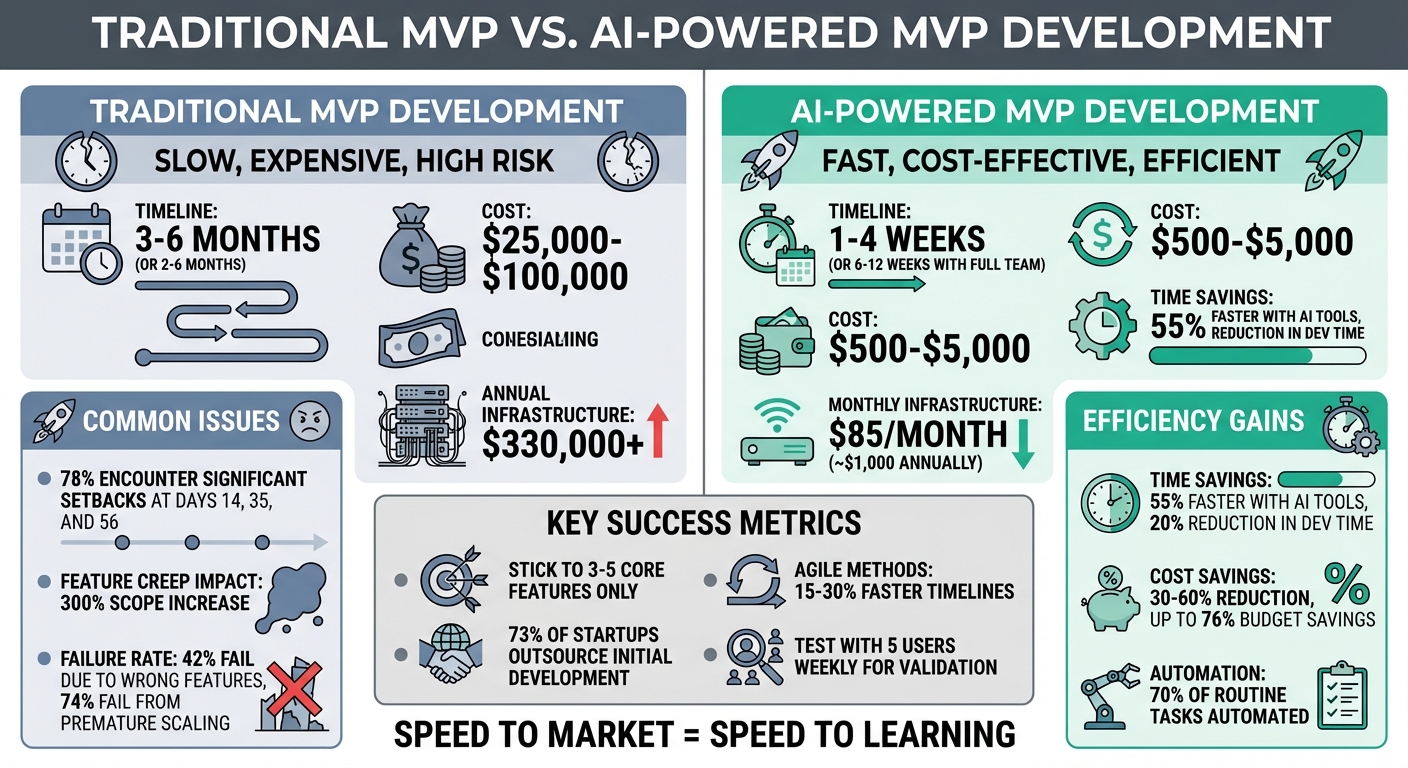
Delays in MVP development often follow predictable patterns. Research shows that 78% of MVPs encounter significant setbacks at specific stages: around Day 14, when design issues arise; Day 35, when pressure to add features peaks; and Day 56, when pre-launch doubts creep in. Spotting these delays early is crucial to keeping your project on track.
Feature Creep: Adding Too Much Too Soon
Feature creep is one of the biggest culprits behind delayed MVPs. It starts innocently - adding "just one more feature" - but quickly spirals out of control. This can balloon your project scope by 300%, transforming a manageable 2–3 month development timeline into a year-long slog.
While the intention is often to deliver a more "complete" product, this approach can backfire. 42% of startups fail because they focus on features instead of solving a real market need. Adding unnecessary extras dilutes your MVP’s core value and delays your launch.
Take Duolingo as an example. When it launched in 2012, the app focused on just 4 languages (English, Spanish, French, and German) and basic vocabulary. This narrow focus allowed the team to validate their idea quickly before expanding to 39+ languages and gamified features later.
"If you don't ruthlessly prioritize, you'll never ship. Every extra feature is an invitation to delay."
- Teresa Torres, Product Discovery Coach
Adding features without proper planning also increases complexity and technical debt, often requiring costly rebuilds. It's a classic case of paying twice: once for building it wrong and again for fixing it.
Unclear Scope and Shifting Priorities
An undefined scope can derail even the most promising MVP. If you can’t clearly articulate the problem your product solves or if your team is constantly debating priorities, progress stalls.
In recent years, decision-making has overtaken development speed as the primary bottleneck. While modern tools can generate code faster than ever, they can’t replace the need for clear direction and focused leadership. First-time founders are especially prone to spending weeks debating ideas instead of testing them.
A well-defined scope means identifying which assumptions you need to validate. For instance, Dropbox didn’t build a full product initially. Instead, they created a simple video showcasing how it would work, which led to 75,000 beta sign-ups - all before writing the actual code.
"If you're not embarrassed by the first version of your product, you've launched too late."
- Reid Hoffman, Co-founder, LinkedIn
Inefficient Development Processes
Outdated workflows can grind development to a halt. Teams that stick to traditional waterfall methods often discover problems too late, leading to costly rework. Agile or Scrum methodologies, on the other hand, allow for faster iterations and quicker problem-solving.
Communication breakdowns can also drag timelines. When developers, designers, and stakeholders aren’t aligned, work gets duplicated or done incorrectly. Simple tasks that should take days can stretch into weeks due to unresolved blockers and unclear priorities.
In today’s landscape, the bottleneck isn’t coding speed - it’s decision-making. While AI can automate up to 70% of routine tasks, it can’t fix slow approval processes or disorganized feedback loops. Overly complex workflows often signal an overengineered process.
Skills Gaps and Team Challenges
Having the wrong team can create delays at every turn. An experienced developer might complete a task in days that could take a junior developer weeks. When your team lacks the right skills or expertise, progress slows - whether it’s a backend developer struggling with frontend tasks or no one understanding how to integrate a critical third-party API.
Experienced founders tend to avoid these pitfalls. They know when to take technical shortcuts for an MVP and when to invest in long-term solutions. Inexperienced teams, however, often over-engineer solutions or cut corners in ways that lead to fragile code, both of which result in delays.
Tight Budgets and Resource Constraints
Limited budgets force tough decisions. Most MVPs cost between $15,000 and $50,000, but poor planning can cause that money to disappear quickly. In small teams, members often juggle multiple roles, which can slow progress when key contributors become bottlenecks.
The temptation to cut corners is strong but often counterproductive. Skipping proper planning to save time usually results in costly rework. Hiring less experienced developers might seem cheaper, but it often leads to more bugs and delays. Similarly, trying to do everything yourself without the right skills can stretch timelines indefinitely.
Budget pressures also create psychological stress. Constantly worrying about costs can lead to second-guessing priorities or delaying launches to add "just one more feature" in hopes of justifying the investment. Notably, 74% of startups fail due to premature scaling, often by trying to do too much with too little.
Fortunately, modern tools have made MVP development more affordable. Using an AI-first stack with tools like Cursor, Claude, and Supabase, infrastructure costs can drop to $85/month (around $1,000 annually), compared to the $330,000+ annual cost of traditional teams using AWS infrastructure. Ultimately, the challenge isn’t just money - it’s knowing how to allocate resources effectively.
How to Speed Up Your MVP Development
If you're aiming to launch your MVP faster, here are some practical strategies to keep your project on track.
Use the MoSCoW Method to Prioritize Features
The MoSCoW Method is a straightforward way to combat feature creep by categorizing features into four groups: Must-have (essential for launch), Should-have (important but not critical), Could-have (nice to include but optional), and Won't-have (out of scope for now).
Here’s how it works. Imagine you’re building a task management app. Your Must-haves might be creating tasks, marking them complete, and setting due dates. Should-haves could include task categories or color coding, while Could-haves might be dark mode or custom themes. Features like social sharing or gamification can go into the Won't-have category for later versions.
One essential question to ask is: "What can be cut from Version 1 to make room for this?" This forces tough decisions and keeps your MVP focused. Stick to 3–5 core features that address the most critical user need. Anything outside this scope can wait for future updates.
| MoSCoW Category | Definition | MVP Action |
|---|---|---|
| Must-have | Features critical to solving the main problem. | Include in the first release. |
| Should-have | Adds value but isn’t essential for launch. | Plan for the first update. |
| Could-have | Optional features with minor benefits. | Add only if resources allow. |
| Won't-have | Features not relevant to the current version. | Push to the backlog for later. |
Another effective tool is the "Aspirin vs. Vitamin" Test. Ask yourself: Does this feature solve a pressing problem (like aspirin) or is it just a nice-to-have (like a vitamin)? For an MVP, focus solely on the "aspirins." To prevent last-minute distractions, consider a feature freeze after the second week of development.
Once you've prioritized, bring your ideas to life with wireframes and prototypes.
Define Scope with Wireframes and Prototypes
Wireframes and prototypes are essential for planning and avoiding expensive rework later.
Start with simple wireframes - even hand-drawn sketches are fine - to outline the main user flows. This helps you visualize how users will navigate your product and spot any logical gaps. Once you’ve nailed the basics, move to clickable prototypes using tools like Figma or AI-powered design platforms.
Prototypes are invaluable for gathering early user feedback. Share your prototype with five potential users each week and observe how they interact with it. This will quickly reveal which features are confusing and which are truly valuable. Feedback like this ensures your development stays aligned with real user needs.
If you're looking to validate ideas without heavy investment, try low-cost experiments. For instance, Renters Rewards, a mobile app startup, tested their cashback idea by emailing 100 users with a $20 credit offer for early rent payment. Over 80% opted in, proving their concept in under two weeks - without building any new infrastructure.
Implement Agile or Lean Methods
Agile and Lean methodologies are perfect for speeding up MVP development. Unlike traditional methods that require months of upfront planning, these approaches focus on short, iterative cycles and continuous user feedback.
"The minimum viable product is that version of a new product which allows a team to collect the maximum amount of validated learning about customers with the least effort."
- Eric Ries, Author of The Lean Startup
While traditional methods can take 6–12 months, Agile and Lean cycles deliver results in just 6–12 weeks. By concentrating on "Must-have" features and eliminating unnecessary steps, startups can cut development costs by 30–60%.
One effective framework is the Design Sprint, a five-day process that takes you from identifying the problem to testing a prototype with real users. Each day has a specific focus: defining the problem (Day 1), sketching solutions (Day 2), deciding on a solution (Day 3), building the prototype (Day 4), and testing it (Day 5). This fast-paced approach prevents overthinking and drives quick results.
With Agile in place, you can also leverage AI tools to speed things up even further.
Use AI Tools for Faster Prototyping
AI tools have drastically reduced the time needed to build MVPs. Tasks that once took days - like market research, wireframing, and even writing code - can now be completed in hours.
For research, tools like ChatGPT, Perplexity AI, and Claude can summarize market reports, organize user feedback, and analyze competitors in minutes. For design, platforms like Uizard and Galileo AI can turn text prompts or sketches into functional wireframes and interactive prototypes, eliminating the need for static mockups.
Code generation has also been streamlined with tools like GitHub Copilot and Cursor, which can automate coding tasks and reduce development time by around 20%. For example, in August 2023, ZoomInfo used GitHub Copilot with their 400+ engineering team. A trial with 126 engineers showed a 20% reduction in development time, with AI-generated code suggestions being accepted 33% of the time. This led to hundreds of thousands of lines of production-ready code - all without sacrificing quality or security.
The cost savings are equally impressive. An AI-first development stack - using tools like Cursor Pro ($20/month), Claude Pro ($20/month), Supabase ($25/month), and Vercel Pro ($20/month) - costs around $85/month. Compare that to traditional development costs, which can exceed $330,000 annually when accounting for salaries of senior developers, designers, and DevOps engineers.
AI-powered approaches can reduce MVP timelines to just 1–4 weeks, compared to the 2–6 months typical of traditional methods. Costs drop to $500–$5,000, a fraction of the $25,000–$100,000 range for conventional development. The key is to focus on "thin slice" development - building only the core functionality to keep cycles short and efficient.
Build the Right Team
The speed of your MVP development depends heavily on your team. Experienced developers can deliver in days what might take less-experienced ones weeks. The right mix of skills and expertise can make all the difference.
For many startups, outsourcing is a smart option. In fact, 73% of early-stage startups outsource their initial product development to gain access to skilled teams without the delays of hiring full-time staff. If you’re building in-house, prioritize developers with MVP experience - they’ll know when to take shortcuts and when to invest in scalable solutions.
Team alignment is just as critical as technical skills. Everyone should understand the core problem your product solves and why certain features take precedence over others. Regular check-ins help maintain focus and catch potential missteps early.
Finally, modern tools can give your team an edge. Developers familiar with AI-assisted coding, no-code platforms, and rapid prototyping tools will move faster than those relying solely on traditional methods. If your team lacks expertise in specific areas - like payment integration or backend scalability - consider bringing in specialists to avoid costly trial-and-error delays.
sbb-itb-765bc22
How ZipLyne Delivers MVPs Faster
ZipLyne brings together AI-powered tools and expert development teams to create MVPs (Minimum Viable Products) that are both fast and market-ready. This blend of technology and expertise forms the backbone of their efficient, AI-driven approach.
AI-Powered Development for Speed
ZipLyne tackles common development delays by automating tasks that usually eat up time. With AI, they can scaffold modules, generate boilerplate code, and set up environments in just minutes. AI code assistants handle the initial drafts, while experienced engineers step in to validate the architecture, ensure security, and align everything with your business objectives. This "human-in-the-loop" method means AI speeds things up, but the engineers ensure the end product is high-quality and avoids technical debt.
On the design side, tools like Uizard and Galileo AI help transform ideas into wireframes and UI mockups almost instantly. This process reduces miscommunication and gets everyone on the same page before any production code is written. Compared to traditional, manual workflows, this approach significantly shortens development timelines.
Custom Solutions Tailored to Your Needs
ZipLyne’s process is built around strict scope prioritization, focusing only on the features that solve your core business problem. This ensures resources aren’t wasted on unnecessary features, keeping the team focused on delivering value.
With experience across more than 150 products, ZipLyne can manage design, backend development, and quality assurance simultaneously. This parallel approach eliminates the delays that often plague first-time founders. Their expertise is particularly valuable in complex industries like fintech and healthcare, where navigating compliance and regulatory requirements can otherwise add months to a project timeline.
Proven Track Record of Fast Delivery
While traditional MVP development can take 3–6 months, ZipLyne’s process delivers iterations much faster without sacrificing quality. By automating repetitive tasks and focusing resources on strategic decisions, they can save up to 76% of the budget. As Paul Jackowski, CEO of ASPER BROTHERS, put it:
"The real game-changer isn't the speed - it's that we can now focus on strategy and user validation instead of wrestling with code."
Speed is critical because 42% of startups fail due to "no market need". The faster you can validate your idea with real users, the better your chances of achieving product–market fit. With ZipLyne, it’s not just about building quickly - it’s about building the right product quickly.
Conclusion
Developing an MVP gets a whole lot faster when you zero in on the core features that matter most. Ruthless prioritization is your best defense against the dreaded feature creep that can bog down progress.
Once you've nailed down your priorities, efficient workflows can take things up a notch. Agile methodologies, for example, can shave 15–30% off your development timeline. Add AI-powered tools into the mix - tools that can speed up processes by as much as 55% - and your time-to-market shrinks significantly.
With a skilled and focused team leveraging AI-driven workflows, you could be looking at delivering an MVP in just 6–12 weeks, instead of the typical 3–6 months.
But here's the kicker: speed isn’t just about getting to market quickly. It’s about learning fast. Building the wrong product is one of the most common pitfalls for startups. By moving quickly, you can gather real user feedback early, helping you validate your assumptions and work toward product-market fit without wasting precious resources.
Whether you’re tackling this on your own or bringing in expert support, the formula stays the same: focus on what matters, automate where you can, and validate your ideas fast. This approach doesn’t just cut down delays - it turns them into opportunities for progress, keeping you aligned with market demands and ready to innovate.
FAQs
How can I avoid feature creep when building an MVP?
To keep feature creep at bay, start by pinpointing the core problem your MVP is designed to address. Identify the must-have features that directly validate your idea. The goal? Deliver the smallest, most effective set of functionalities that bring real value to your early users. Any extra features can wait for future updates. A clear problem statement and a prioritized backlog - sorted by impact versus effort - are great tools to keep your scope tight and focused.
Once you've nailed down your feature set, it's crucial to enforce strict boundaries during development. Agile practices like sprint planning can help you evaluate new requests and ensure only those that align with your MVP's core purpose get the green light. Setting a feature-freeze date before launch is another effective way to maintain discipline and avoid unnecessary delays.
After launch, roll out your MVP to a small group of users and gather their feedback. Use these real-world insights to guide future updates, instead of relying on guesswork or speculative features. This method ensures your MVP stays on track and aligns with what the market truly needs.
How can AI tools speed up MVP development?
AI tools are a game-changer when it comes to speeding up MVP development. They simplify and automate critical tasks, making the process faster and more efficient. For example, generative AI can whip up prototypes, design UI mockups, and even generate boilerplate code in a fraction of the time it would usually take - what once required weeks can now be done in days. This not only slashes development time but also trims costs by reducing the need for extensive manual effort.
Beyond that, AI handles repetitive tasks like setting up frameworks and writing routine code, freeing up developers to focus on more strategic and creative aspects of the project. During user testing, AI-driven insights can identify which features are most important and help fine-tune the product based on actual feedback. This ensures your MVP remains streamlined and in sync with market needs. By improving workflows and boosting efficiency, AI tools make it possible to deliver high-quality MVPs faster and with fewer resources.
Why is it essential to define a clear scope for your MVP?
Defining a clear scope is crucial for the success of your MVP. It ensures your team focuses on addressing the core problem with only the essential features needed to validate your idea. This approach keeps development efficient, steering clear of unnecessary additions that can drain time, money, and resources.
A clear scope also helps you avoid scope creep, a common issue that can lead to missed deadlines, budget overruns, and project delays. By establishing well-defined objectives from the outset, you can stay on course, bring your product to market faster, and gather valuable feedback early on. This keeps your MVP lean, purposeful, and in tune with user needs, boosting its chances of success.