
How to Launch a Viral Product: Strategies from 45+ Successful Launches
Launching a viral product isn’t about luck - it’s about planning, design, and execution. Here’s a quick summary of how successful companies achieve explosive growth:
- Start with AI-driven market research: Use tools like Google Trends and sentiment analysis to identify market gaps and validate product ideas quickly.
- Build an MVP fast: Use AI tools to streamline development and focus on creating a product that users will love, not just one that works.
- Design viral loops: Embed sharing and referral mechanisms into your product to drive organic growth.
- Run a pre-launch campaign: Build anticipation with waitlists, referral rewards, and user-generated content.
- Leverage social media: Tailor your strategy to platforms where your audience spends time, and use challenges or influencer partnerships to amplify reach.
- Partner for growth: Collaborate with brands or individuals that align with your audience to expand visibility.
- Track and iterate: Focus on metrics like viral coefficient and retention rates to refine your product and ensure long-term success.
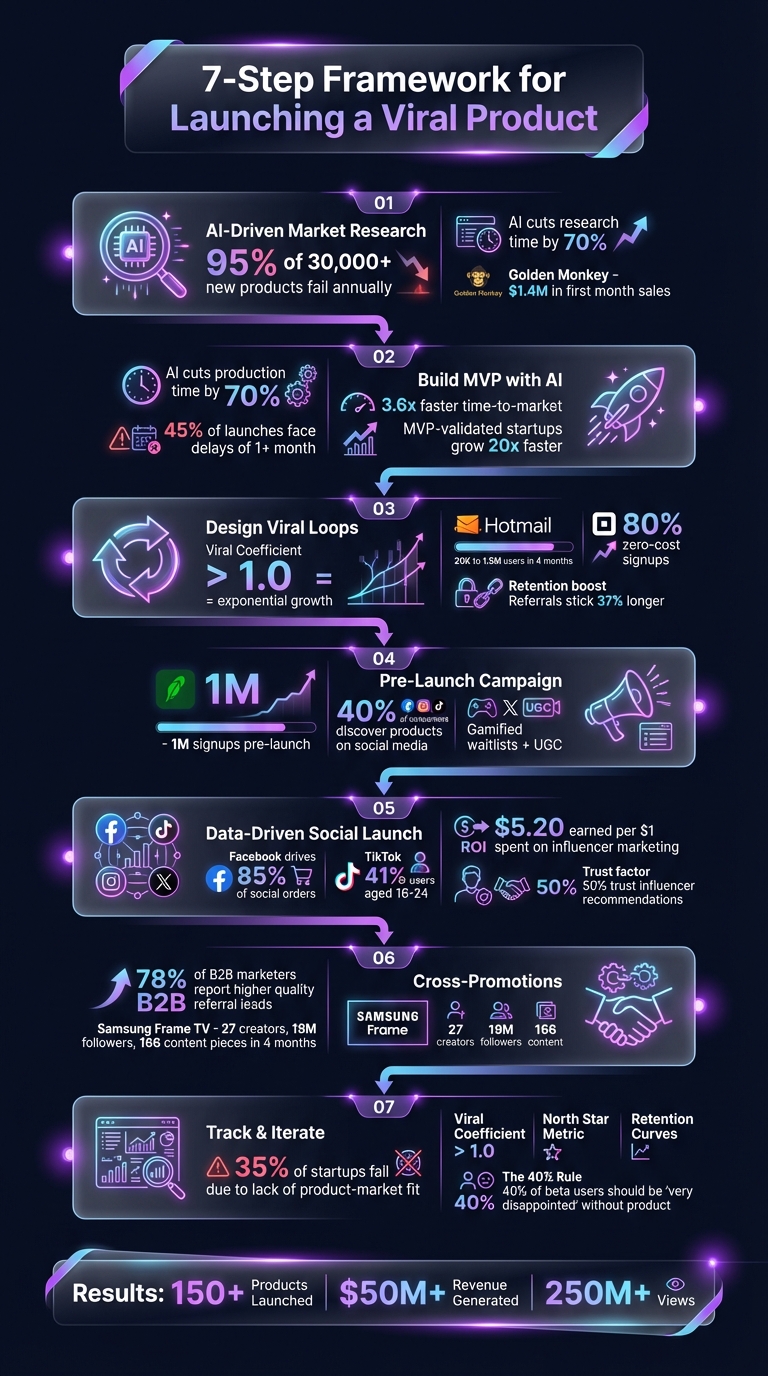
7-Step Framework for Launching a Viral Product with Key Metrics and Success Rates
My COMPLETE Product Launch Strategy
sbb-itb-765bc22
Step 1: Validate Product Ideas with AI-Driven Market Research
Did you know that about 95% of the 30,000+ new products launched each year fail? That’s a staggering number, but AI-driven market research is changing the game by identifying customer needs before development even begins.
In the past, traditional market research could take weeks to deliver insights. Now, AI tools can cut that time by up to 70%. This speed means you can test multiple product ideas quickly, narrowing your focus to concepts with the highest potential.
Using AI to Spot Market Opportunities
AI shines when it comes to finding opportunities that might slip past human researchers. Tools like Google Trends and Exploding Topics can highlight emerging market demands before they go mainstream, giving you a competitive edge. On top of that, AI-powered sentiment analysis dives into customer reviews, social media chatter, and online forums to uncover specific pain points that existing products fail to solve.
Take Under Armour, for example. In 2019, the company used Qualtrics to scale its testing from 100 to 10,000 participants. This fast feedback loop allowed them to refine the HOVR cushioning platform through multiple iterations. The result? The HOVR Infinite shoe earned a Runner's World Award shortly after its launch.
Similarly, Golden Monkey, a candy manufacturer with three decades of experience, found a gap in the gummy candy market. The result? They raked in $1.4 million in sales during the first month alone.
The secret lies in AI’s ability to map the entire market landscape - what’s already out there, who’s being served, and where the gaps are. This "whitespace" analysis happens before you start designing anything. By identifying opportunities early, you can lay the groundwork for viral product design and development. Next, let’s explore how predictive analytics takes this process even further.
Testing Product Concepts with Predictive Analytics
Once you’ve zeroed in on a market opportunity, predictive analytics can help you forecast whether your product concept will click with your audience. Tools like NewsWhip analyze emotional triggers and sharing potential, giving your idea a viral prediction score.
Yamaha is a great example of this in action. They use the Qualtrics platform to run hundreds of rapid studies during product development. These studies deliver detailed customer feedback in just hours, compared to the weeks traditional methods require. This speed helps Yamaha catch potential missteps early, allowing them to fine-tune products before they even hit the prototype stage.
Platforms like Wynter also play a critical role in validating messaging. You can test landing page copy, product descriptions, and positioning statements with real B2B panels before launch. This ensures your message strikes the right chord with your target audience.
"The biggest mistake in viral content isn't poor quality - it's poor empathy. Understanding your audience's worldview is more important than any tactic." - Ann Handley, MarketingProfs
To stand out, consider shifting your focus from creating a Minimum Viable Product (MVP) to a Minimum Lovable Product (MLP). Instead of just testing whether a product works, use AI-driven insights to ensure it delights users from day one. This approach not only builds brand loyalty faster but also minimizes the risk of launching a product that works technically but fails to connect emotionally.
Companies that embrace AI-powered validation tools are seeing a 3x increase in product experimentation. But it’s not just about experimenting more - it’s about experimenting smarter. By letting data guide your decisions, you can avoid relying on instinct and focus on ideas that are more likely to succeed. This sets the stage for smoother development down the line.
Step 2: Build an MVP with AI-Powered Development
Once your idea is validated with AI-driven insights, it’s time to move quickly into product development. The key here? Speed without sacrificing quality. AI-powered tools can cut production time by up to 70% while maintaining high standards. That’s a huge advantage, especially when delays plague 45% of product launches, often pushing timelines back by at least a month.
By leveraging AI in the "Build-Measure-Learn" cycle, you can create the leanest version of your product to test your core business hypothesis. This approach ensures you stay laser-focused on what truly matters, avoiding wasted effort on features that might not add value.
Accelerating Development with AI
AI tools are transforming how quickly technical tasks get done, often completing work in minutes that used to take hours. This shift lets your team focus on higher-level priorities like strategy and user experience.
Take PepsiCo, for example. In 2025, they used Miro's AI-powered collaboration platform to streamline global product planning. By centralizing their processes with AI-driven blueprints, they brought new products to market 3.6 times faster than their previous methods. Similarly, WebMD tapped into AI for feedback analysis, boosting product improvements by 60% per quarter by better understanding customer needs.
AI also shines in visual prototyping. Tools like Midjourney and HeyGen allow you to create high-quality mockups and digital demos without the hefty price tag of manual development. These tools cut creation time by 45% and enable three times more experimentation. As a result, you can produce a polished MVP that aligns with market demands faster than ever.
Balancing Speed and Quality in MVP Creation
Speed is critical, but it shouldn’t come at the cost of quality. The trick is knowing when to lean on AI and when human input is essential. AI can handle tasks like drafting Product Requirements Documents (PRDs), generating user stories, and creating initial wireframes. This keeps your team aligned from the start and eliminates lengthy planning cycles.
"Building an AI MVP in 15 days isn't a neat marketing tagline. It's a viable approach that helps you get your AI idea off the bench and in front of users quickly."
- Harram Shahid, InvoZone
Deploying your MVP via containerization tools like Docker on AWS or Azure ensures scalability and consistency. Startups that validate their ideas with an MVP grow 20 times faster than those that skip this step. The sooner you get feedback from real users, the faster you can refine your product and edge closer to product-market fit.
However, don’t rely entirely on AI. Human oversight is essential for maintaining an emotional connection with users. Remember, 74% of startups fail due to premature scaling - pouring resources into feature-rich products before confirming their core assumptions. The sweet spot lies in balancing rapid delivery with thoughtful refinement. AI helps you move faster, but your team’s insight ensures you’re building something that truly resonates with users.
Step 3: Build Viral Loops into Your Product Design
Your MVP is ready - take a page out of Square's playbook: 80% of their signups come with zero acquisition cost because their hardware is visible every time it’s used in a store. That’s the power of a well-designed viral loop - it transforms your users into a built-in marketing engine.
Here’s how these loops work and how to weave them into your product.
What Are Viral Loops?
A viral loop is a self-sustaining system where users organically introduce your product to others just by using it. Unlike casual word-of-mouth, viral loops are deeply embedded in the product’s core functionality.
"Consumer product startups have to bake a viral channel into their product from the get-go. They can't merely glue it on later."
- Gabor Cselle, Former CEO, Pebble
There are two main types of viral loops:
- Pull virality: Users invite others to gain value, like Slack or Zoom.
- Distribution virality: Shared content itself drives adoption, as seen with Instagram or Loom.
The key metric to watch? Your viral coefficient. A number greater than 1.0 means exponential growth - each user brings in more than one new user.
Take Hotmail, for example. Back in the late 1990s, they added a simple tagline - "Get your free email at Hotmail" - to every outgoing email. That tiny feature helped them skyrocket from 20,000 users to 1.5 million in just four months.
Adding Sharing and Referral Features
Now that we’ve covered what viral loops are, let’s talk about adding sharing and referral features to your product. The best referral programs work because they reward both the referrer and the new user.
In 2008, Dropbox nailed this with their two-sided incentive: both the referrer and the friend got 500 MB of free storage. This clever loop helped them grow rapidly while keeping infrastructure costs manageable. Similarly, Gusto offers $100 to both parties when a new payroll account is created, doubling the motivation to share.
The trick is to make sharing feel natural. Don’t hide referral options in a menu - integrate them into the user experience. For instance, Loom includes clear calls-to-action on shared video links, encouraging recipients to try the product right away. Robinhood tapped into competitive instincts and FOMO by letting referrals move users up their waitlist, which helped them attract 1 million users before launch.
Referrals aren’t just a growth hack - they’re a retention booster. Customers who come through referrals stick around 37% longer. Plus, word-of-mouth drives 44% of signups, with direct referrals adding another 12%. When you build these mechanisms into your product from the start, you’ll lower acquisition costs and scale faster than traditional marketing ever could.
Step 4: Run a Pre-Launch Campaign to Build Anticipation
Your product is ready, and you've baked in viral loops to encourage growth. Now, it’s time to get people talking before launch day. A well-executed pre-launch campaign can turn casual interest into genuine excitement, transforming strangers into enthusiastic early adopters.
The best pre-launch campaigns go beyond just collecting email addresses - they turn your waitlist into a powerful growth engine. Take Robinhood, for example. They used a gamified waitlist that displayed user rankings and offered referral rewards. This approach played on FOMO and competitive instincts, resulting in nearly 1 million signups before their official launch. The waitlist wasn’t just a list; it became part of the experience itself. To add even more momentum, consider incorporating user-generated content (UGC) into your strategy.
Using User-Generated Content (UGC)
UGC is a fantastic way to boost credibility and create buzz. Seeing real people share their experiences with your product often carries more weight than traditional advertising. It feels genuine, relatable, and trustworthy.
A standout example is Apple's #shotoniPhone campaign. By encouraging users to post their own photos with a branded hashtag, Apple generated over 24 million Instagram posts, each serving as proof of their camera’s quality. You don’t need Apple’s budget to replicate this. Start small: launch a hashtag challenge that highlights your product’s best feature. Get a few early adopters to kick it off, and watch it grow.
Another idea: tie social sharing to early access. Tools like "Pay with a Tweet" allow you to require a social media post in exchange for joining your waitlist or accessing exclusive content. It’s simple, effective, and makes every share count - especially since 40% of consumers discover new products on social media.
Building a Waitlist for Early Access
Your waitlist isn’t just a signup form - it’s your first chance to market your product.
For example, Mint offered VIP early access to users who displayed a Mint-branded badge on their blogs or websites. This tactic helped them grow from zero to 1 million users in just six months. These badges served as digital endorsements, while also giving early adopters a sense of exclusivity. Similarly, the anonymous polling app TBH used a school-by-school exclusivity model to build demand. Within nine weeks, they had 5 million downloads and were acquired by Facebook for $100 million. Both examples show how a creative waitlist strategy can fuel viral growth.
Keep your signup process simple - just one email field and a strong call-to-action. Once someone joins, send a welcome email with a unique referral link and show them their position on the waitlist. This creates a sense of urgency and encourages sharing.
"The more friends you get to sign up for the waiting list, the higher up your position on the waiting list becomes."
- Neil Patel, Co-Founder of NP Digital
Track your viral coefficient to measure success. If each waitlist member brings in more than one additional signup, you’re on the path to exponential growth before your product even launches. This simple yet effective strategy sets the stage for long-term success.
Step 5: Launch with Data-Driven Social Media Strategies
It's launch day! With your waitlist ready and excitement already brewing, it’s time to focus on your social media strategy. Social media can make or break a launch. In fact, 40% of consumers discover new products through these platforms, making them a crucial part of your distribution plan.
The trick is aligning your product with the right platform and audience. For instance, Facebook drives 85% of social media-generated orders, making it a go-to for direct sales. TikTok is where Gen Z dominates - 41% of its users are aged 16 to 24. Meanwhile, Instagram is a favorite among professional photographers, with 98% of top pros using it. If you're in the B2B SaaS space, LinkedIn is your best bet, while developer tools often thrive on X (formerly Twitter). The key is to meet your audience where they already spend their time.
When it comes to content, avoid the temptation to cross-post the same material across platforms. Each platform has its own vibe. For example, a polished product demo might work wonders on LinkedIn, but TikTok users prefer raw, relatable clips that show your product in action. Experiment with different formats to see which channels bring in the most engaged traffic and conversions, then double down on those. Pair these efforts with viral loops to keep the momentum going.
Running Social Media Challenges to Drive Engagement
Social media challenges turn passive viewers into active participants. They’re effective because they encourage people to engage, create, and share - all while organically promoting your product.
Take IHOP’s bold move in June 2018. They temporarily rebranded as "IHOb" (International House of Burgers) to promote their new burger lineup. The campaign sparked 7.5 million views and a massive online buzz, successfully drawing attention to their non-breakfast menu. This shows how a simple, shareable challenge can create a surge of interest.
The best challenges are straightforward. Use a branded hashtag that highlights your product’s standout feature. Encourage early adopters to share their experiences, results, or creative uses. Sweeten the deal with perks like early access, exclusive rewards, or public recognition. The easier it is to join and share, the more traction you’ll gain. After building momentum with a challenge, partner with influencers to amplify your reach even further.
Working with Influencers to Amplify Your Launch
Influencers can give your launch an instant boost by connecting you with audiences that already trust them. On average, businesses earn $5.20 for every $1 spent on influencer marketing, making it one of the most cost-effective strategies around. But it’s not just about follower counts - focus on influencers who genuinely align with your niche and have actively engaged communities.
"4 in 10 millennials report that their favorite influencers understand them better than their real-life friends."
Give influencers early access to your product and let them create authentic, unscripted content. Overly scripted posts feel forced and can turn audiences off. Use tools like unique referral links or discount codes to track which influencers are driving real results, not just impressions. Once you identify who’s delivering sign-ups or sales, reinvest in those partnerships.
"Launch posts that visually show the product solving a real problem beat text-heavy announcements every time." - Socialmon
Step 6: Scale Growth with Cross-Promotions and Partnerships
After a successful launch and leveraging viral loops, the next step is to broaden your reach through well-planned partnerships. These collaborations can connect you with thousands - or even millions - of potential users without breaking the bank. The trick? Partnering with brands or individuals whose audiences naturally align with your own, while crafting campaigns that offer value to everyone involved.
Finding the Right Partners
The best partnerships are those where the audiences overlap naturally. If your target market includes Gen Z, for instance, platforms like TikTok are a natural fit - 41% of TikTok users fall between the ages of 16 and 24. For B2B products, look for businesses in complementary industries where your tool can solve shared challenges.
Focus on complementary use cases, not direct competitors. Think about products where collaboration is key - like project management tools, communication platforms, or design software. These create what’s known as "Pull Product Virality", where users organically share your product because it enhances their experience. For example, if you’ve developed a scheduling tool, teaming up with a CRM platform could make sense, as their users might need your solution to coordinate meetings with clients.
Don’t forget about distribution networks that can integrate your brand into everyday workflows. Seek partners who can showcase your product’s benefits directly to their audience - through badges, reports, or widgets, for example. And since roughly 50% of consumers trust influencers for purchase recommendations, prioritize partnerships with people or brands that already have credibility with your target audience.
Co-Marketing Campaigns That Deliver
Great co-marketing campaigns create value for both parties and make sharing effortless. Take Intercom, for example. They embedded branded links into their chat widgets, turning every site visitor who clicked into a potential lead. Similarly, TripAdvisor offered embeddable rating badges that hotels and restaurants could display on their websites. This not only boosted TripAdvisor’s visibility but also helped hospitality businesses showcase their credibility.
Another example comes from Samsung, which partnered with 27 creators between 2021 and 2022 to promote their Frame TV. Together, these creators had a combined following of over 19 million and produced 166 unique pieces of content in just four months. Samsung didn’t need to create all the content themselves, and the creators brought authenticity to the campaign while reaching highly specific audiences.
To maximize results, structure partnerships with two-sided incentives - reward both the person sharing and the person receiving the invitation. This ensures everyone gets immediate value, making the program more sustainable. Use referral links or discount codes to track which partnerships are driving conversions, and double down on the ones that work. In fact, 78% of B2B marketers report that leads from referral programs are higher quality than other sources, making these collaborations a smart investment.
Once you’ve implemented these cross-promotional strategies, the next step is to keep a close eye on your metrics and refine your approach for sustained growth.
Step 7: Track Metrics and Iterate for Continued Growth
After launching, keeping a close eye on metrics is crucial for refining your growth strategy. Ignoring important data can lead to setbacks - 35% of startups fail due to a lack of product-market fit. The challenge lies in identifying the right numbers to track and using feedback effectively to keep pushing forward.
Key Metrics to Track
Start with a North Star Metric - a single, overarching measure of your product's success. This could be something like Monthly Active Users (MAU) or completed transactions. Once you’ve pinpointed this, break it down into supporting KPIs that align with your growth phases:
- Pre-launch: Leads generated, waitlist signups.
- Launch: Conversion rates, customer acquisition costs.
- Post-launch: Retention curves, engagement depth.
Another critical metric to monitor is your Viral Coefficient (VC), which shows whether your product has the potential for exponential growth. A VC greater than 1.0 means each user is bringing in more than one new user, fueling rapid expansion. Pair this with your Viral Cycle Time - the time it takes for a new user to refer someone else. The shorter this cycle, the faster your product can grow.
Retention is where the real story lies. Metrics like likes or shares might look good on paper, but flat retention curves tell you if users are sticking around after experiencing your product’s value. Combine these quantitative insights with user feedback to confirm product-market fit. Then, use this data to zero in on meaningful improvements.
Using Feedback to Improve Your Product
Just like in the early stages, continuous iteration is key to sustaining growth. The trick is to filter out unnecessary noise and focus only on clean, actionable data. Take Superhuman, for example. This email startup, launched in 2015, used a detailed 15–20 question survey and manual onboarding to ensure they were targeting high-volume email users. By excluding feedback from users outside their niche, they preserved strong retention rates and benefited from powerful word-of-mouth growth.
Beta testing and early access groups are invaluable for spotting issues before they escalate. Watching session replays can also reveal where users encounter friction or drop off, giving you clear opportunities for UI/UX improvements. Lastly, pay attention to Feature Product Fit - when a specific feature boosts retention or engagement without creating new problems. This kind of insight helps you identify which updates drive growth and which might derail your progress.
How ZipLyne Can Help You Launch a Viral Product
Launching a product that catches fire in the market takes more than just a great idea. It demands smart planning, technical know-how, and proven methods that turn ideas into products people can’t stop talking about. ZipLyne specializes in delivering exactly that. With experience in launching over 150 products, they’ve helped generate $50 million+ in revenue and racked up more than 250 million views for their clients.
Complete Product Development from Start to Finish
ZipLyne takes care of every part of the product development journey. From AI-powered research to creating a minimum viable product (MVP) and designing for virality, they’ve got it covered. Their use of AI-driven market analysis pinpoints gaps in the market and validates ideas, cutting production time by up to 70% without sacrificing quality. What’s more, they embed viral loops - referral systems that reward both sharers and new users - right into the product design. This strategy creates the kind of network effects that drive explosive growth.
The development process follows a structured, four-step framework: understanding what motivates users to share, defining the "viral carrier" (the element users share), picking the best distribution channels, and ensuring new users see immediate value. This method turns products into engines of organic growth, reducing the reliance on paid advertising.
Once the product is ready, ZipLyne applies time-tested launch strategies to maximize its impact in the market.
Results-Driven Strategies That Work
ZipLyne’s expertise spans digital products, physical goods, and viral brands, helping businesses sidestep the mistakes that often derail product launches. Their approach is designed to tackle challenges head-on, using a three-phase strategy:
- Pre-launch campaigns: Build excitement with waitlists and user-generated content.
- Data-driven launch execution: Use insights to optimize launches across social platforms.
- Post-launch optimization: Refine strategies based on real-world metrics.
Whether you’re a startup founder needing an MVP in record time, a business looking to integrate cutting-edge tech, or an entrepreneur scaling a physical product, ZipLyne delivers the speed and focus needed to turn your product idea into a viral success.
Conclusion: Your Roadmap to Viral Success
Achieving viral success isn’t about luck - it’s about intentional planning and quick execution. The strategies shared here are drawn from an analysis of over 45 successful product launches, offering you a tested framework to turn your product idea into reality.
"Virality is a business design problem, not a marketing or engineering effort." - Andrew Chen, General Partner, Andreessen Horowitz
This framework simplifies earlier insights into actionable steps. Here are three key priorities to focus on:
- Viral Coefficient: Ensure your viral coefficient is above 1.0. This means every user brings in more than one new user, fueling exponential growth.
- Cycle Time: Shorten your viral cycle time. The faster users share and engage, the quicker your product gains momentum.
- The 40% Rule: Validate your product by testing whether at least 40% of beta users would be "very disappointed" if they couldn’t use it. If you hit this benchmark, you’re ready to launch.
From using AI for idea validation to crafting an engaging viral loop and leveraging data for a strategic launch, these steps create a clear path to success. Start by tackling your most pressing challenge - whether it’s validating your idea, building your MVP, or planning a pre-launch campaign.
The companies that achieve viral success don’t wait for perfect conditions. They act decisively, test relentlessly, and adapt based on real user feedback. Apply these priorities now to build momentum and sustain growth long after your launch.
FAQs
How can AI-powered market research help ensure a successful product launch?
AI-driven market research takes the guesswork out of understanding your audience by processing massive datasets like social trends, search patterns, and past sales figures. This helps businesses pinpoint customer challenges, forecast demand, and focus on the features that truly matter. For instance, AI can assist in setting competitive prices (think $49.99) or identifying the best marketing channels, ensuring smarter budget use and a stronger return on investment.
But it doesn’t stop there. AI keeps an eye on customer behavior in real time, detecting new trends and predicting how different interactions influence engagement. These insights empower teams to tweak messaging, experiment with viral concepts, and fine-tune prototypes faster. By weaving AI into every stage of the launch process, businesses can make more informed decisions, minimize risks, and dramatically boost their chances of delivering a product that resonates with customers and gains momentum naturally.
What is a viral loop and how does it help a product grow?
A viral loop happens when users of a product naturally bring in new users, setting off a cycle of organic growth. Think of it like this: a user might share a referral link, invite their friends, or post content created with the product. Those new users then do the same, helping the product spread quickly through personal networks - all without the need for paid advertising.
What makes viral loops so effective is their ability to lower customer acquisition costs while driving rapid growth. When designed well - using features like referral rewards, simple sharing tools, or incentives for inviting others - the product essentially markets itself. This approach builds trust through word-of-mouth and creates momentum for fast, scalable expansion.
Why is a pre-launch campaign important for building excitement around a new product?
A pre-launch campaign plays a crucial role in building anticipation and generating buzz around your product before it officially becomes available. By offering sneak peeks, teasing upcoming features, and encouraging early sign-ups, you create a sense of curiosity and excitement. This not only raises awareness but also positions your launch as a big event, rather than something that flies under the radar.
But it’s not just about creating hype. A well-planned pre-launch strategy helps you gather a community of engaged, enthusiastic users who are ready to take action as soon as your product goes live. Tools like countdowns, exclusive early-access invitations, or referral rewards can inspire organic sharing and expand your reach. Plus, this phase gives you a chance to learn more about your audience - what excites them, what they’re looking for - so you can fine-tune your messaging and product features for a stronger launch.